Not only a diagram of the Great Opera but almost a compendium of the last cooking. And not only. The table by J. De Semlecque on Brouaut’s was long a musical conundrum. There are three authors to consult: Canseliet, Atorène, and Martianus Capella.
How often have we been presented with this engraving as a typical example of the Ars Musicae, the art of music, in Alchemy? But all this might not even be enough; how many times have we heard of “music of the spheres” imagining it so distant from operative Alchemy? In a sense, it is, but not as much as we imagine. Martianus Capella, in his “Wedding of Philology and Mercury,” deals precisely with this: the levels of notes that the girl Philology must “ascend” to get to her betrothed, Mercury. If we add that Mercury is Alchemy itself, we begin to have suspicions about what she has to go through. The subject is so complex that separate articles will be devoted to the purpose. Given that the image we are facing presents Basilius as the main subject, let’s talk about operational alchemy.
We were also told that the organ’s pipes in the picture were proportional, but the comparative relations were left unknown. If Canseliet unveiled the exact weights at every “whistle” (1), Atorène revealed the proportions in all their Pythagorean meanings.
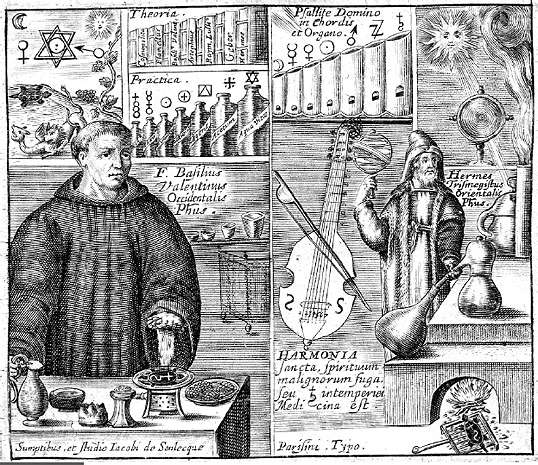
Before having Atorène explain the arcane, let me examine the image. Taken from the frontispiece of Jean Brouaut’s “Traité de l’Eau de Vie”, Paris 1646, is signed by Iacobi, Jacques, de Semlecque, who wishes us to know that the composition is the result of his studies and work. The engraving is divided into two parts. On the left are the preparatory and the main works, and on the right is the third work, or last cooking (see an Opus Magnum scheme).
The seven containers on the left part, under the seven books written by seven authoritative ancient alchemists, do symbolize the seven (six plus one) repetitions of salt volatilizations, from raw matter to the Mercurius Philosophorum, marked by the so-called Seal of David, which is nothing more than the emblem of our Solve et Coagula (2) perfect accomplishment. Volatilizations or upward movements, the Sun and plant, and consequent downward or liquifying phase, the Moon.
The turtle stands for the “rock” raw matters to be opened with the black putrefactive phase, the first to let “Spirits” come out. The same black turtle is on the Basilius table; the chosen matters must be reduced in black Saturn. Blackness will be a recurring cyclic phase till the last work.
In the end, and after the fixation, we obtain our Prima Materia, the symbol of the Sun inside the seal, or two intermingled triangles. The phases in between are not so important to deserve symbols and definitions per se. The increasing bottle dimensions refers to the “quality” of the mercurial salt, which will be formed inside, not quantity, which is instead bound to be less as we go. Maybe the author needed seven increasing bottles to justify the seven increasing organ pipes on the right, with real operational reasons.
If a skilled or lucky alchemist can reasonably hope to go through the preliminary and main works, the third work is set aside for the few artists with the knowledge and the courage to afford it (not me). So they must choose the right time and week (as the ecliptic globe suggests). Then they have to build the philosophical oven, set the Egg, and operate the fire according to the increasing weight of the Egg. The black turtle on the grill does mean the need for a skilled fire regimen.
Generally, to indicate the seven sounds from the Philosophical Egg, the alchemic symbolism relies on the representation of a seven-string viola present in the image. But to hint at what happened inside the Egg, we need an organ, an instrument in which every pipe is different and peculiar in dimensions.
Under the viola, a latin sentence can be read: “Harmonia Sancta, Spirituum malignorum fuga seu ( Saturn Symbol), intemperiei Medicina est”, the Sacred Harmony, also said place of banishment of the envious spirits, is the Medicine of arrogance.
Often we hear of a sacred octave, and we know a series of seven notes is an octave. Still, the past alchemists preferred to refer to the phenomenon of the last cooking as an “Organ” or a series of pipes manufactured in sizes according to the wanted notes. And this is not precisely what in music is called an “Octave”. But we can build an octave on every note.
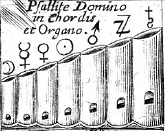
Finally, note the series of Planets labeling the pipes: they are arranged differently from the series of planets meaning the rotation of colors. Here the series of planets ends with Saturn-Kronos, who used to be the starting point, not the arrival, in other alchemical stairs. Here we are dealing with music, so this is a density stair, which can be found in the Empireum above the Elements.
In this regard, the sentence over the organ gives a real clue: ” Psallite Domino in Chordis et Organo”… let’s chant to the Lord with Strings and Organ. In musicology, the strings are, per antonomasia, a symbol of mathematical proportion. It is time to let Atorène, much more learned than me in the topic, tell us about the weird proportions of the organ’s pipes, or better, the Egg weights. My translation from “Le Laboratoire Alchimique”, Paris 1981:
The Cooking of a Master.
It was performed on May 1951, and sadly went to a stop, but the generous philosopher offered it as a gift to Science lovers. He published a partial record in ” L’Alchimie Expliquée sur ses textes classiques”.
Tuesday, May 15, inside the Athanor:
-Vase of the Art (crucible, etc) 148.90 g.
-Vase of Nature (2)
remora 4.15 g.
salt 160.55 g.
Total Egg weight 313.60 g.
At 9 p.m. the heating is started.
First Sound Tuesday, May 15; at 10.32 p.m.
(duration: 100 seconds) Egg weight: 313.60 (unchanged)
Second Sound Wednesday, May 16; at 10,10 p.m.
Egg weight: 333.65 g.
Third Sound Egg weight: 354.80 g.
Fourth Sound Egg weight: 368.60 g.
Fifth Sound Egg weight: 396.00 g.
Sixth Sound Egg weight: 423.50 g.
Seventh Sound Egg weight: 440.60 g.
Monday, May 21. The cooking came to a stop. We are not going to know anymore.
Thus seven whistles have divided the time, seven musical notes whose pitch is crescent. To manage the cooking, hasn’t the alchemist the most wonderful checking system? If the cooking were successful, an eighth whistle would have sounded when the ponderal Octave was disclosed. We will get the meaning as we go.
Table of Weights
Now look at the variations of weights, not those of the device, but those of the philosophical vase instead; it is enough to subtract 14.90 g. from each measure. We get:
at first sound 164.70 g.
at second sound 184.75 g.
at third sound 205.90 g.
at fourth sound 219.70 g.
at fifth sound 247.10 g.
at sixth sound 274.60 g.
at seventh sound 291.70 g.
Now we will present the results with four decimals without rounding them.
1) we will divide every weight by its initial weight, and
2) we will divide every weight by the previous weight.

Indeed, the reader accomplished in music theory will open her/his eyes wide at this point. A suitable course is prepared for the other ones at Atorène, Music Theory Course for Alchemists—part 1.
- Canseliet and the Art of Music and Weight , Hieronymus Bosch and the Concert in the Egg , Piero della Francesca and the Philosophical Pendent Egg and Nicaise le Febvre and the Egg inside the Egg , The Secret Night Chant of a Stradivarius Tree ;
- The Vase of Nature is the Egg and is inside the vase of Art ;
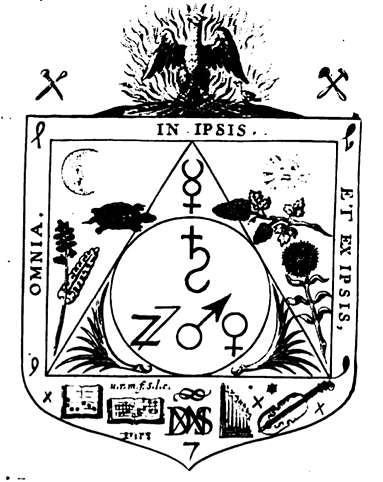
- Jacques de Semlecque beautified the last page of Jean Brouaut’s Traité de l’Eau de Vie with another engraving of his own, widely known as “emblem”, with a conspicuous musical part in the lower part, but probably this time out of the contest. Canseliet uses quite identical emblem from an XVII century manuscript about works of Philalethes other from Introitus to philosophize on the phoenix. The original diagram was a colored drawing. Jacques de Semlecque engraved a copy and added the musical part at the bottom. As well as a baby phoenix and engravers tools such as small hammers and chisels at the side of the Phoenix. So the musical score with a diatonic scale seems here a mere decoration.
