The assembling instructions of the famous Orthelius marble sponge to capture the celestial influences in a corporeal medium in this fifth chapter of his commentary on Sendivogius.

My translation from Latin in quotation marks, my comments in regular: Theatrum Chemicum Zetzneri Argentorati, Orthelius Commentator in Novum Lumen Chymicum Michaelis Sendivogii. Chapter V, Tome 6, page 413:
“Title On the attraction of the air in water, as well as of the proper medium in which that corporeal and earthly liquor gets life and impregnation by means of astral beams.
The text is interrupted by a short sermon: the catching of the air for possibly five or six months.”
For air, Orthelius means the aerial part of the Secret Fire/Spiritus Mundi to be extracted from the atmospheric humidity.
“Sendivogius, in his section ” On the Enigma,” states that water is everywhere, and nothing can live without it. It is drawn in wonderful ways, but the absolute best is the following: extracting it with the power of our chalybis, found in Aries’s belly. Very few know it ( when Sendivogius says,” the central part and occult food of life is in the air), while the many are used to see only the rind or shadow of the thing.”
The Sendivogius infamous sentence word in Ventre Arietis, or in the belly of Aries, has taken off sleep to many alchemists. Orthelius mentions it again in the first chapter ( Orthelius Commentary on Sendivogius. Chapter I): “… For this reason, it is fair to say the human Rebis ϰαἔ έξοχήν exceeds all other excrements, nonetheless, from our experience, it is known that the ovine droppings (of which, in the undercover mention IN VENTRE ARIETIS, Sendivogius sufficiently turns the topic into a dry louse… in latin: hanc quaestionem satis sicco pede transit) … that look-alike earth or simple or prepared should be achieved and extracted at the beginning of Spring, with the Sun entering the sign of Aries (1)”. Let’s resume the fifth chapter now:
“The same in the epilogue. Nature has a proper light, unavailable to our eyes. On the other hand, the shadow of nature is within our eyes. But if the light of nature irradiates and the shadow discharged from our eyes lifts, the point of our magnet corresponding to both the center of beams and sky and earth can easily manifest.
Again. Every creature invisibly uses it. And from her comes all the things in the world. But there is nothing special in her; however, everything unique is combined in her.
In addition to the water taken from the air, the water is then distilled from snow and the December air frozen on the trees. Concerning other systems, the water from hail is preferred in summer because of its darting lightning.”
It follows the description of the marble sponge, whose translation I decided to keep strictly verbatim. I can only avoid alleviating the author’s ambiguity by maintaining the text’s integrity; in fact, there are many clearly intended vague details in the sponge description. I’m aware that the raw literal rendition will lead to a very involute technical account of a bizarre implement, but on the other hand, this was the author’s desire. The scheme in some points emerges so bizarre that it may even appear as an allegory for something else rather than a device with any actual use:
” Sidenote: a way to attract the air: beyond the above presented, there are other systems to extract the air in the water substance, one of those is given without veils: a copper implement ( instrumentum cupreum) or even one or more imitations of the here presented model, from two or three parts ( ex duabus vel tribus partibus… ) accordingly cemented is prepared (this is my only interpretation. The original is … constantia optimè ferruminata parantur).
A giant sea sponge ( magna spongia balneatoria) is placed in the inferior part, to which are added two pounds of marble calcined for five days and nights in a furnace for glass ( quae duabus libris Marmoris per quinque dies & noctes in fornace vitriaria calcinati) and broken in pieces (confracti) together with a pound of red marble ( cum una libra Marmoris rubri) as big as an Avellana walnut ( a slightly larger nut than the standard) and mixed with calcined marble ( & cum calcinato marmore mixti, gravatur), so to be forced through an inferior small tube and in combination with a small container.”
Before going ahead and having information on the actual role of the sponge, as well as of the calcined and shattered marble, it can be interesting for the reader to know that the nomenclature “sponge”, when found in a seventeenth-century alchemical treatise, sometimes hides a salt or a set of salts very predisposed to act as sponges for atmospheric humidity, and consequently for the Spiritus Mundi/Secret Fire from the sky. To improve their sponge-able quality, those salts must previously undergo long calcination at a crucible or furnace, a common way to free them from any previous water and make them ready to absorb humidity again. Not common salts, though, but preferably salts very keen to reintegrate the water molecules incorporated in the crystalline structure lost when heating at high temperatures.
However, Orthelius doesn’t present a salt hydrate here ( like copper sulfate CuSO4, for instance), but marble is a relatively pure calcium carbonate mineral (CaCO3). Anyway, as he recommends for the marble to be long heated in a furnace (actually five days), one wonders whether the CaCO3 mineral’s use would be purely mechanical ( to give weight to the sponge) or chemical. So far, the author just tells us to heat till complete oxidation, break the marble into pieces, and assemble it in the very odd implement. But, if merely for mechanical purposes, why recommend two types of marble?
Concerning marble chemistry, the ancients have long known how to transform in quicklime, which is obtained by high-temperature baking of limestone, marble, shells, or other materials containing calcium carbonate. In the heating phase, the chemical reaction CaCO3 → CaO + CO2 occurs (calcination reaction), which leads to the liberation of carbon dioxide and the production of calcium oxide or lime, an alkaline substance. After baking, stone fragments reduce their weight by about 40% because of the carbon atoms and oxygen lost and assume a porous texture. Then to obtain the hydrated lime or slaked lime, the material must be subjected to the power-off reaction: CaO + H2O → Ca (OH) 2, associated with two obvious macroscopic effects: a violent heat release and disintegration of the stone for the expansive effect of the transformation from oxide to calcium hydroxide. Anyway, Orthelius wants us to know that the calcined marble powder will be added to the sea sponge, and the implementation will rely on this odd combination for absorbing the humidity, as we will see further on. But he reserves to the title the necessary notion that the sponge has, in this way, become a “marble sponge” filled with pounds of calcium carbonate (after the calcination process, it is calcium oxide, though).
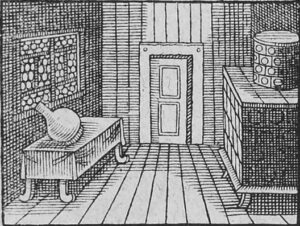
In the next paragraph, the author recommends placing the implement in the peculiar environment represented below, which he describes with the name Hypocaust, or “hot room” (of course, what may appear as a huge caisson actually is a large tiled stove):
“The warmer the hypocaust where the implement has been placed, the colder the outside of the window. Through the superior part of the implement, it can be collected little by its lowest part in the small orifice and narrow like the eye of a needle; it continues, in this drawing implement, even more water is gathered, and eventually through the sponge pressed by the burden marble (per spongiam à marmore gravante pressam), flows from it in the adjacent vessel. To satisfy the need, the drink may be sufficient for horse and man.”
The hypocaust engraving doesn’t explain whether the window’s glass was removed in the adjacency of the container’s neck. Orthelius says nothing in this regard, so we don’t know whether there was an air turnover in the room or not. Additionally, he is unclear whether the water has just to pass through or to be entirely gathered in the sponge (per quam superior instrumenti pars, ab infima sui parte paulatim in angustissimum & strictissimum orificium quod acus cupidem recipere queat, protenditur, tantò citius etiam & plus aquae in hoc instrumentum attractorium colligetur & tandem per spongiam à marmore gravante pressam, in vas suppositum defluet).
Has Orthelius ever put his scheme into operation? Or the impossible implement is just an allegory for something else the author cannot wholly unravel? As for now, he concludes the paragraph with a surprise:
” I saw similar round objects (globos) made of gold, silver, copper, and aurichalco, with which cold water, even very cold, was pulled towards and applied as quickly as possible, and with which excellent effects took place, which with no doubt was the intention of his opera. But to that will be reserved the right time and place.”
In fact, I was wondering where the copper part mentioned in the beginning ended up and soon disappeared from the description. Does the globe make the container function, or is it the real implement hidden inside the flask we see in the drawing instead? Or is the same flask actually made of copper, gold, and silver? Materials that act as powerful natural attractors for Spiritus Mundi/Secret Fire.
Moisture condensation forms on the less warm part of the implement, like on an underground cellar door during a hot summer. As for lime, it is excellent at absorbing moisture but must be handled carefully as it can damage skin and eyes ( above, we have seen why). In ancient times they placed a jar with quicklime to remove humidity in cellars and basements.

Previous chapter at Orthelius Commentary on Sendivogius. Chapter 4.
The next chapter is Orthelius Commentary on Sendivogius. Chapter 6.
- A suggestion of mine: start to consider the week before the official equinox peak, as the official day is often already too late;
- See for a comparison Bacstrom’s Apparatus to Attract Lunar Humididy.