An unexpected uncombed Madonna on a Perugino painting. However, a Sun painted on her shoulder easily reveals the reason: she is our Secret Fire main catching system. Because, in Alchemy, the astronomical sun is the wind’s incubator.
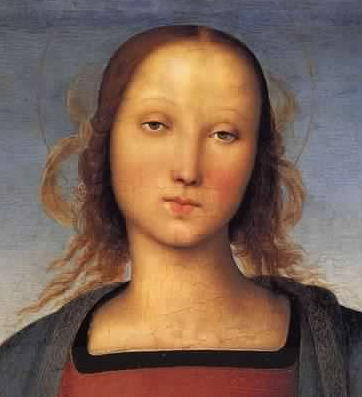
Renaissance, moreover, in Italy, was the hair-styled age for antonomasia. Wealthy women spent a considerable amount of their time having their hair perfectly combed and architecturally arranged. So Pietro Perugino models in all his paintings.
In Greek mythology, married women have their hair styled precisely and accurately, while virgins – back then, women with no social ties with men – could wear their hair down and unkempt. Christian mythology wants the mother of Christ to have conceived her son as a virgin, that is, in a free condition. But this Madonna’s iconology of her hair ruffled by the wind is truly unusual. The painter tries to stop the turmoil with ribbons in her hair. But all in vain.
This “Madonna col Bambino”, or Madonna with child, is unique in the Italian fifteenth-century painter repertory. But it also features another detail: the tiny sun embroidered on the left side of her cape. We know that the left side was synonymous with secret knowledge and inaccessible to most. Now it’s all about connecting hair tousle to the sun.
The canvas we are examining wasn’t a Perugino’s highlight. I can only find it mentioned in Vittoria Garibaldi’s Pietro Perugino Catalogo Completo or the complete catalog, Octavo Edizioni, Firenze 2000. You can get an introduction to this painter in Pietro Perugino and the Black Horned Motherhood (1); in that article, I scrutinized another solar Madonna, the Decemviri altarpiece, that madonna also has an embroidered sun, but the presence of black recalls an entirely different version of symbolism: putrefaction and the suggestive achievement of perfect black. Alchemy, as strange as it may seem to us nowadays, was the mainstream culture of a renaissance artist. And back at that time, symbology hadn’t a mere decoration reason.
This windblown Madonna in this Perugino’s canvas is different. She is neither Giorgione’s white woman nor the putrefactive dark queen, like the Madonna mentioned above in Decemviri Altarpiece, who was instead comparable to Primitive Mercurius. She is antecedent to many Mercurii but successive to others. For example, she is not an allegory of the “Cosmos” world, our solar system world, the Moon, or a Mercurius Sideribus from Stars.
We must give a meaning of operational Alchemy to this logo of the sun. In Alchemy, a Sun painted everywhere other than in the sky is always a symbol of Secret Fire/Spiritus Mundi. But also of Soul/Sulfur. So it could indicate both fixity and volatility, dissolvent and dissolved, Macrocosm and Microcosm, and so on. In almost every article, I warn you that every alchemical symbol has at least three meanings and that Secret Fire is our First Matter. On the ubiquitous Sun-Moon symbology, I have already written some articles. As well as motherhood.

The Winds and the Sun in Mythology
The winds are born from two opposing forces; even the ancients knew it. It was said that in Arcadia, two winds blow under the constraint of great necessity; it is a somewhat complex concept to understand, but it seems to have been the basis of divination. In fact, they are intimately linked to the idea of life, death, and destiny. The ancient Greeks may have identified this girl with the goddess Ananké—the deity of great necessity.
The Winds and the Sun in Alchemy
Our unpretentious girl has borne a child. Or, better, she is her child and perfectly able to replicate herself and nourish. In alchemical iconographies, all personages are different moments of the same thing.
Already for the ancient Romans, the wind had connections with the sun. From the deification of some images that stood in front of the doors of the houses, and therefore exposed to the sun – see hinges and caryatids – they are supposed to derive the winds from the sun’s position. See the wind rose, which is actually the sun’s position and, therefore, of the ecliptic. Ultimately, for the ancients, the winds come from the sun.
Their physics was much more mythological and less experimental than ours, so in his Trattato dell’Origine delli Venti, or treatise on the origin of the winds, Breventano, in 1571, openly declared that wind and sound had a similar origin. The consequences of these beliefs, which, I repeat, are of mythological origin, have always been enormous for the ancients’ concept of atmospheric air. the consequences of these beliefs, which, I repeat, are of mythological origin, have always been enormous for the ancients’ concept of atmospheric air. Which is the water element, let’s not forget it, that is, of what flows. The ancient Greeks said that the gods were those who flowed. In fact, the Olympian deities all had attributes of ineffable smoothness.
She primarily represents Secret Fire – from the solar symbol on her shoulder – but both as a perceptible natural movement; since she is the perceptible natural movement, she is the “flowing”, a denser Secret Fire carried by the atmosphere, the “Flowing Net” which gets hold of Secret Fire corpuscles and brings them down to the ground for us.

But, as we will see in Kriegsmann’s commentary on Tabula Smaragdina, the Wind symbol also stands for physical rain-snow-dew. Together with the Wind/alchemical net, they grasp the Secret Fire bouncing from the moon. And together with the Net, they are flowing phenomena. So, no wonder that the alchemical element Water does represent them. Not Air.
Bottom line, this free girl is nature itself. But an alchemical nature. Bottom line, this free girl is nature itself. But an alchemical nature. The difficulty in describing her is that the lady of the wind is a real portal to Alchemy.
- Pompeii Mysteries Villa: a Gentle Flowing with Mystica Vannus;
- Kriegsmann: Sun, Moon, Wind and Earth in Tabula Smaragdina ;
- Voynich Manuscript and the Unknown Part of the Rhythm , Nuisement and the Sun Resisting Capture ; Two Stars in a Geocentric Venetian Sky;
- Nuisement and the Sun Resisting Capture;
- Codex Marcianus Ouroboros; Antonio Persio’s Trattato intorno all’Ingegno dell’Huomo ;
- Vestals and Dolabra: the Rite of Fire and Water; Albrecht Dürer and the Backwards Apollo;
- The Throne Hieroglyph and the Nightly Power of Isis; Pietro Perugino and the Decemviri Black Horned Motherhood;
- Sun and Moon at the Turn of the First Millennium; Philosophia Reformata, Father Sun and Mother Moon;
- Basilius Azoth, Salt or Philosophers Gold?