The Peg Leg symbol is displayed in Philosophia Reformata in an explicative environment: the need for perfect wedding dress measurement.
The Philosophia Reformata character with the artificial leg has often been referred to as Hephaestus, perhaps because the god of blacksmiths and forges was depicted in mythology as limping and trudging after Zeus. Other legends say that, for this reason, Hephaestus was present in every area of the earth to repeat the ineffable celestial fire. We will see at the end of the article if the operational requirements are suitable for the poetry of the repetition of the ineffable fire even in the recesses of the earth. But I tell you right away that Mylius is very prosaic.
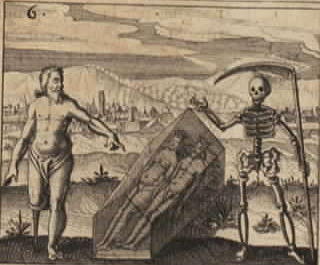
Substituting a human leg bone with a wooden prosthesis is rarely seen in the alchemical symbology. Still, we know Johann Daniel Mylius loves learned and erudite symbology. In Philosophia Reformata, Frankfurt 1622, Lucas Iennis publisher, directly sets the Peg Leg character where we cannot fail to give him a suitable interpretation: besides our freshly married alchemical pair.
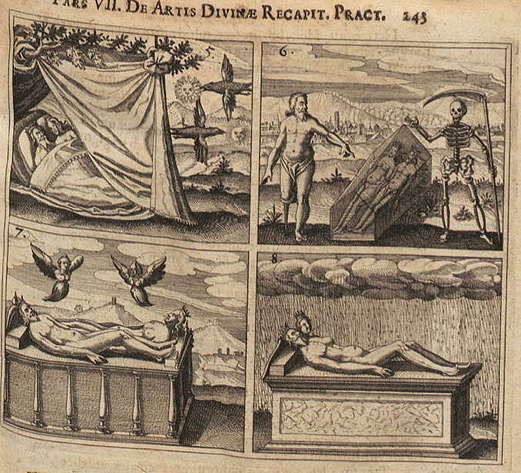
On Philosophia Reformata page 243, we find four images of our alchemical newlyweds. They are made: the woman is the result of serial salts volatilizations, so our Mercurius ( the end of preparatory works). The man is the so-called Sulphur. Nevertheless, he comes from the female Mercurius. They are our Mercurius Duplicatus (1). There are two thought schools. The first states the volatile Mercurius needs to be fixed and made Earth, and for this purpose, our calcinated metallic powder ( called Sulfur) may be useful to slow our girl, who in turn will be happy to dissolve him.
The second is that our metallic boy, before getting married, should first be dissolved into a Mercurius; the dissolution then is to be dissolved again by an official marriage, the beginning of the Main Work ( see an Opus magnum scheme). This operation is not symbolic, but to make sure the metal is very dispersed, much more than a single dissolution. The more the metal is dissolved and dispersed, the faster it turns dark till real blackness. This is the beginning of a “Reincrudation” (2).
Sometimes, the Mercurius is filled with Secret Fire to dissolve the metallic powder without further strong distillation or sublimation. This seems not to be the case with Philosophia Reformata image number five. Two eagles carry Suns and Moons back and forth: the Moon represents the volatilizing phase, while the Sun represents the following downward moving, or simply fixation. Eagles are allegories for lifting or raising operations.
Now the male spouse is supposed to be sufficiently dissolved, and the couple is put to putrefy in image number six. They are tightly closed in their crystal alcove and naturally turn black; the male can get dispersed.
This is a Saturnian phase, Regimen Saturni, well represented by the scythe-holding skeleton. A skeleton because they are being born from salts, and a scythe they are to die or putrefy. Let’s aside, for the moment, the Peg Leg character. We see in image number seven that the two are deceased during the deadly phase, as their spirits of life abandon the corpses. Nevertheless, they are tightly closed inside the vessel to prevent their spirits of life from flying away and keep them from descending again ( image number eight).
Mylius defines image number five as “Conjunctio sive Coitus”, that’s to say Conjunction or Coitus. He says: ” Coniunge ergo filium tuum Gabricum… cum sua sorore Beya”, tie your son Gabricus with his sister Beya. As the sulfurous metallic male is to be dissolved into a Mercurius girl. They are born by the same mercurial mother.
Beya ascends to merge Gabricus and includes him in her uterus. But there is no generation without Gabricus… of course, he is the “seed”. All will be converted in Gabricus nature.
Image number six is presented as “De Conceptione sev Putrefactione”, that’s to say, on conception or putrefaction. Mylius defines the operation as an Earth putrefied with its Water, in this way, is purified. There is in this chapter a long disquisition of masculine and feminine seeds according to the seventeenth-century idea of the seed as a masculine prerogative and the ground of gestation as a feminine prerogative. This latter idea was likely just an alchemic reminiscence. The female Mercurius could act as a uterus to an external observer. Although a uterus was shaken by turbulence, the marriage is not that “quiet”. The male Mercurius ( many call it Sulphur, indeed) tends to agitate the girl ( love fight). Apart from that, to be defined as a ground, it must be more in volume and weight than the seed.
We know that Beya dissolves Gabricus, incorporating him. Gabricus agitates Beya. Consequently, we need more Beya than Gabricus. Also, bear in mind the metal should be twice dissolved.
Here, Peg Leg could find his role script. The character is strangely naked, just a piece of fabric to hide his low parts. From the greatest antiquity, gods and heroes were represented as naked characters to emphasize that they were above and beyond humankind. So Peg Leg is not a human; he is an entity representation—a weigher Mercurius.
The replaced leg under the knee is a tibia, a bone. In my article on the Latin word radius and the Greek ράβδος, I omitted the anatomy meaning, the rod-staff bone. In the marriage of the Virgin and Joseph, I said the Virgin might also represent the sacred knowledge, while Joseph the carpenter is the proportions maker ( radius also means “geometry) (3).
Any alchemist knows that we need the exact proportions for the marriage to be successful. Not to mention that sometimes we need someone officiating for the wedding ceremony, an additional Secret Fire/Mercurius. But, always, all in the suitable proportions. In the image we are examining, Peg Leg points at the couple closed inside the crystal alcove. The vessel should be perfectly geometrically planned, not to let any Spirit of Life flee outside, and inside, the “weighs” are to be carefully observed and implemented. The more Beya, the less Gabricus and a bit of an officiant priest. The earth cannot putrefy without water, a preponderant part of water: “… una parte corporis videntur accipienda propter putrefactionem trigesima sextae partes aquae.” For acceptable putrefaction, one part of the body and thirty-six parts of water (Water is our water, the Mercurial Beya).
Hephaestus or Vulcan? The vessel has already been tightly closed—Les jeux sont faits. Our newlyweds now have to fend for themselves.
In regimen Saturni, once closed, we need proportions. We have to sew an oversized, sumptuous wedding dress for the Mercurius girl. That will be a Peg Leg, the measurer, task.
As often happens in treatises from the Baroque era, the authors are not interested in illustrating a didactic way and write with their path in mind. It’s a pity because, in this way, we don’t know how generalistic the legend that wants Hephaestus repeater of Zeus on earth is.
- See also Atalanta Fugiens and Mercurius Duplicatus ;
- See also Atalanta Fugiens and the Golden Apples ;
- See also Raffaello Sanzio and a Rod Semantics ;