In Traité de la Chimie chapter five, Christophle Glaser starts affording operations suitable to seventeenth-century chemistry and Alchemy in the Renaissance and Baroque periods.
We will often encounter this chemistry in preparatory works or Labors of Hercules. Alcoholizing, Amalgamating, Calcinating. But before Glaser brings to an end the notions of active-passive.
“Chapter V or Five.
On Passive Principles, Phlegm and Earth.
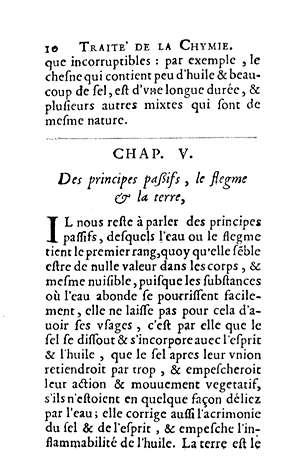
It remains for us to mention the passive Principles. Among them, water or phlegm holds the first place, which seems to be of no value in the bodies and even harmful, because substances, where there is a lot of water putrefy easily, they do not cease to have their use, it through water that salt dissolves and incorporates with spirit and oil if they were not in some way untied by water, salt after their union would keep too much, and would prevent their action and vegetative movement; and it also fixes the salt and spirit acrimony, and prevents oil flammability”.
If you remember, in Chapter 1, Glaser considered five principles, not only three. Mercurius- Sulphur-Salt is defined as active. Indeed they are movements, not molecules. Glaser states that Mercurius appears in solved bodies. Renaissance and Baroque age chemists didn’t search (and were not asked) for molecular purity. Alchemists are not interested either, for they destroy mass to get Secret Fire or Quintessence. The day chemistry discovered molecular purity was the separation day from Alchemy. It is clear enough that Mercurius is sometimes intended as ineffable Secret Fire, a pure movement, and sometimes a mass or vehicle for it. That’s the difference between first matters and second matters or Materiae Secundae. Returning to Glaser’s description, focus on the extreme reduction to all varieties of molecular substances only according to their state of matter, namely liquid, viscous liquid, and solid or powdery.
“Earth is the last of principles, and despite being regarded as unhelpful in natural mixtion, it does not give up on being necessary since it holds the salt and other active principles, which could easily be dissolved and washed away by water. When completely deprived of the others, it is called damned earth; it is scarcely necessary for chemistry except to moderate the salts flowing, and we estimate it is unnecessary to speak further”.
Have you ever heard of salts flowing? But if we get to think of salts in the sense of Azoth, namely a Mercurius plus Sulphur, or better, a too much volatile Mercurius turning into a Fixed Mercurius or Sulphur and so then acquire the new name of Mercurius Philosophorum, in this case, we understand that ”flowing” has to be limited to becoming “handling”. The Secret of the Art is about these hidden proceedings.
“Chapter VI or Six.
Various operations that are used to open and reduce mixed in their principles.
Mixed taken from vegetables and animals are infinite in number and result in very different substances in hardness, strength, weight, softness, porosity, and levity. It forced artists to seek any means to overcome and to use an infinite number of necessary operations, following the outer shape of mixed, they have to in alphabetical order:
Alcoholizer is reducing solids in very subtle and impalpable powder, and divest and purify the spirits and essences from Phlegm and impurities they can contain; for that reason well, rectified spirit of wine is called alcohol when it is separated from its phlegm”.
Pay attention because here, the spirit of wine might also be the alchemical Spirit of Wine, francais spirit de vin ( wine) phonetically resembles Esprit Divin or Divine Spirit.
Spirit or Principle of Life or Mercurius. But we know that a powder can only be a Mercurius Philosophorum or a Fixed Mercurius. Calcinated. or Ventilated. So here, Glaser uses Alcohol in Arabic as a very subtle powder, not in a Western chemical sense.
“Amalgamate means calcinating some metal utilizing quicksilver, that’s to say of vulgar mercury,”
Amalgam is commonly intended as the kneading of gold, silver, and any other metal with quicksilver or argentum vivum. But here, the chemical proceeding Glaser is not a common sense operation. He speaks of calcinating, which is a reduction in powder, as we will see further on. The useful operation, if we want to sow a metal in its alchemical earth Mercurius Philosophorum. Indeed:
“This operation ( Amalgamate) is useful to reduce perfect metals in very small particles for when they are incorporated together, mercury is being exhaled little by little, and gives the metal reduced in powder at the bottom of the crucible…”
Do not be so sure of a dry way targeting because of the word “the crucible”: we are here not told yet if a menstruum is to be involved. Indeed now Glaser finds use for this metallic powder:
“… and makes it more available to be dissolved in liqueur by menstruums: this operation is familiar to goldsmiths and gilders, which makes gold fluid and extensible on the items one wants from gold: Please note that iron and copper do not amalgamate with Mercure, these metals are very impure, and terrestrial, having little to do with Mercure, a substance which is subtle and pure”.
We cannot put a piece of metal into Universal Dissolvent (neither in chemical dissolvents, you could); we need a subtle powder for the use. Menstruums were dissolvents at large where a wet way is involved—chemical and alchemical. Like many of his age chemists, Glaser considers Alchemy the most excellent Chemistry. You can discover why this operation is in my post on gold putrefaction in terra alba foliata. And now Glaser afford Calcination:
“Calcinate is to reduce in calx or powder by the actual or potential fire; actual fire is our ordinary and material fire that we obtain from combustible materials, such as wood, coal, and others: the potential one is the strong waters fire, and corrosive spirits; calcination serve better minerals than vegetables and animals, which may be calcinated simply by burning, but minerals and metals require very active and violent fire, as we teach in practice.”
Glaser here draws the essential difference between metallic and vegetal spagyric. Metals are difficult to sublimate and need a menstruum or dissolvent, which cannot be Aqua Regia. Sometimes, the vegetal world may provide a dissolvent also for metallic use: Hollandus gives us a “recipe” for the use. Calx or powder essentially are oxides or other salts. We all know that gold is pretty difficult to reduce in salts. But, as aforementioned, we cannot think of “plunge” as a pure little piece of gold in Alcahest.
To be continued at Glaser 4 Chemical Operations
Previous chapters: